actor - an absurd man - on stage
Like Sisyphus, I am an absurd man. Since my discovery of Camus’ THE STRANGER and later on THE MYTH OF SISYPHUS, I live a life that embraces the absurd; I am an artist, I am an actor.
In 2027, at 75, I return to the stage to honor an achievement from more than 50 years ago. In 1977, innocent yet driven, I began a journey that shaped my life as a theater artist—one defined by questioning, exploration, and self-discovery. This performance reveals my process of becoming the actor exploring and creating Camus’ Caligula and Meursault, making each transformation visible to the audience.
an absurd man - His Sound of Being Alone
Center Stage Theater, Santa Barbara, CA | September 13 - 26, 2027
I performed this one-man piece in Studio A at UC Davis’s Department of Dramatic Art: the absurd man - the actor - taking on Caligula and Meursault.*
Caligula (from the 4-Act Play) - a grotesque monster of a man unwilling to accept the pain of his mortality at the onset of grief.
Meursault (from the short novel THE STRANGER) - an ordinary man who shoots someone on the beach and does not cry at this mother’s funeral.
I appeared on stage as Caligula haggard from his journey away from the palace. Upon Caligula’s return he addresses himself in the mirror of his chamber. He is distraught about the death of his sister and being unable to hold the moon.
Between the monologues the actor wiped off Caligula, changed costumes.
The lights came up on Meursault in his prison cell with light coming through one of the barred windows.
At the completion of the second monologue the actor exited the stage.
The everyday man is drawn to the theater, where many lives are shown to him and he can experience another person’s poetry without sharing their pain. When the play ends, he does not remain; he returns quickly to his own life, moving toward one hope or another.
The actor, an absurd man, begins where the everyday man leaves off. No longer content to admire the play, he longs to enter it. By stepping into many lives and experiencing their variety, he chooses to act them out.
The actor points us toward what is most certain: the immediate life that is lived, tested, and passing. With only hours, he becomes a character, brings a life into being, and ends it on a small stage. What remains are gestures, silences, breath, and passion—all soon gone. In that brief time, he must live and express an extraordinary life, losing himself to find himself as he crosses in hours the dead-end path the everyday man spends a lifetime traversing.
Paraphrased from Albert Camus’ The Myth of Sisyphus.
* At the only performance at UC Davis, the following was a program note: This thesis is about a man being alone . . . in the world and on stage. The final write-up of the thesis will be the blending of my critical research of Camus’ “absurd” man and the realizations that have been discovered during the rehearsal and performance of the character piece. Neil Diamond once wrote: “But I got an emptiness deep inside | And I've tried | But it won't let me go | And I'm not a man who likes to swear | But I never cared | For the sound of being alone”. I agree with him. In my need of help to realize this project, the tolerance and support of these people have brought me to this moment: Ruby Cohn, leading me into and the the monologue scripts, Wendy Salkind - teaching me, by example, what the creative process can be, Cheri Vasek - showing me how to build Venus and Caligula, Leslie Clark - bringing about all the “magic” which allows the piece to live on stage, Roy Wilcox - developing the image of the Actor, Caligula and Meursault, And, all those who were curious enough about the project to listen to and talk to me about it - helping me to become more lucid about the written aspects as well as this part of the thesis.
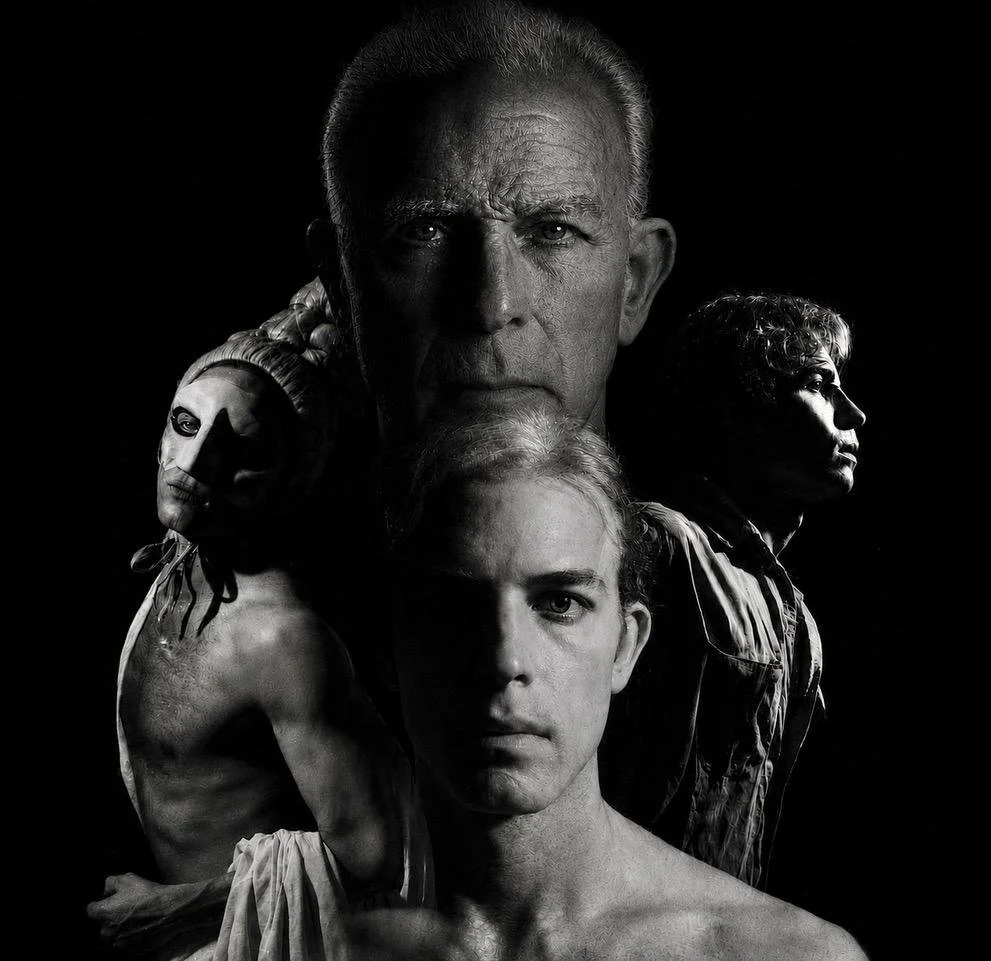
Photo composite: Baron Spafford (original image: Roy Wilcox)