absurd man - Sisyphus
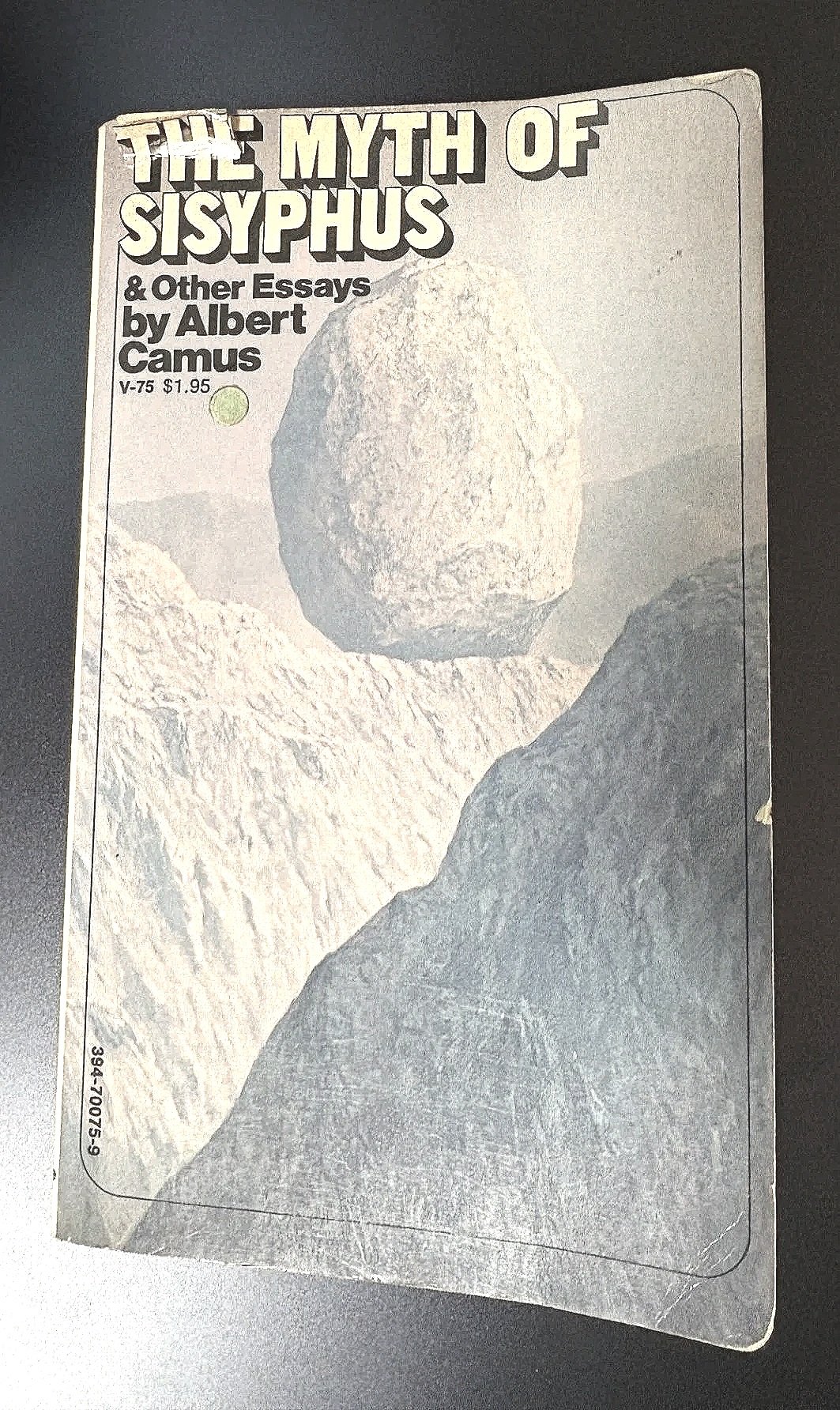
“For the absurd man it is not a matter of explaining and solving, but of experiencing and describing.
For Camus, Sisyphus becomes the most absurd of men when he recognizes his “feeling of absurdity” and continues living within an irrational world.
Sisyphus, a legendary Greek mortal, dies and awakens in the dark underworld, longing for the earth’s beauty. The gods allow him to return briefly, but “when he had seen again the face of this world, enjoyed water and sun, warm stones and the sea, he no longer wanted to go back to the infernal darkness.” (Camus, The Myth of Sisyphus)
Sisyphus rejects the underworld and ignores the gods’ summons, refusing to leave the light he loves. For this defiance, he is seized and condemned “ . . . to ceaselessly rolling a rock to the top of a mountain, whence the stone would fall back of its own weight.” The gods believe “there is no more dreadful punishment than futile and hopeless labor.” (Camus, TMoS)
In Camus’ version, Sisyphus sees the fallen rock, returns to it, and chooses his response. He recognizes himself within the irrational task of pushing the stone up the mountain. He could deny the task by imagining the rock broken or at rest, or escape it through suicide. Instead, he pushes again, refusing to see his life as merely futile and accepting himself through the actions of his fate.
Camus moves Sisyphus from repetition into consciousness, where “his fate belongs to him.” As he turns back toward the rock, his scattered actions become a fate he has made, carried in memory, and sealed by death. Camus turns this futile cycle into a metaphor for human toil.
Sisyphus pushes his rock as a person lives: moving through routine until self-recognition interrupts him. (Camus, TMoS) Returning to the rock, he confronts himself, accepts his task, and discovers freedom within it. For a moment, he steps back from existence, knowing himself through what resists him and seeing his place in an irrational world that will outlast him.
In his essays, Camus describes four absurd archetypes: Don Juan, who repeats uncommitted passions; the Actor, who lives temporary roles; the Conqueror, who acts within futile history; and the Creator, who makes art without eternal promise. Each chooses a purposeless life and fully inhabits its irrational demands. Each experiences and expresses a life of focused action; each embodies his absurd life.
Camus concludes: “I leave Sisyphus at the foot of the mountain! One always finds one’s burden again.” Sisyphus defies the gods, lifts his rock, and finds the universe “neither sterile nor futile.” Each fragment of the stone becomes a world, and “the struggle itself toward the heights is enough to fill a man’s heart. One must imagine Sisyphus happy.”
In this performance piece, I stand as the actor—an absurd man.

Albert Camus (THE MYTH OF SISYPHUS)
THE MYTH OF SISYPHUS and Other Essays by Albert Camus (translated from the French by Justin O’Brien)